There is a special kind of person in every family, every friendship circle and every workplace.
The fixer.
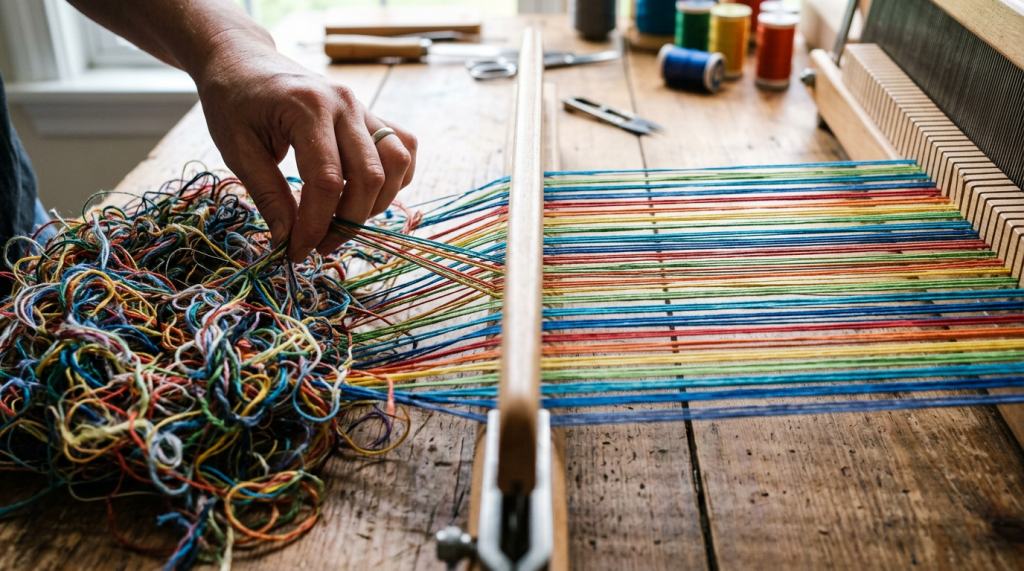
A person weaves vibrant multicolored threads on a wooden loom.
You know who they are. They are the ones people call when things go wrong. They are the calm voice during a crisis, the problem-solver when everyone else is stuck, and the person who somehow finds a way forward when there doesn’t seem to be one.
For many years, I wore that badge with pride.
In fact, most leaders do.
We build careers and businesses on our ability to solve problems. We become known for our reliability, our resilience and our willingness to carry more than our fair share. The better we become at fixing things, the more people bring us to fix. And that’s where the trouble begins.
What nobody tells you is that being the fixer comes with a hidden cost. The cost is not the workload. The cost is becoming everyone’s first call and your own last priority.
Somewhere along the line, many fixers start believing they have to have all the answers. They become uncomfortable asking for help because they are the ones who are supposed to provide it. They keep moving because stopping feels selfish. They keep carrying because putting the load down feels like failure.
The irony is that the people who spend their lives solving problems are often the least likely to admit when they are struggling.
I’ve learned that leadership is not about carrying everything. It is about knowing what belongs on your shoulders and what doesn’t. I learnt this lesson the hard way after almost falling apart from stress and “demand”
Not every problem is yours to solve. Not every fire requires your attendance. Not every challenge needs your intervention. Sometimes the most effective thing a leader can do is step back and allow others to step forward. If they don’t take the step forward, perhaps they are not the right person to be part of your army.
That doesn’t mean abandoning responsibility. It means creating space for growth. Teams become stronger when they are trusted to solve problems. Relationships become healthier when responsibility is shared. Businesses become more sustainable when they don’t rely on a single person holding everything together.
The truth is that fixers need fixing too. They need rest. They need support. They need permission to be human. Most importantly, they need to understand that their value is not measured by how much they carry.
The world will continue to produce problems. There will always be another challenge waiting around the corner. Another crisis. Another curveball.
The goal isn’t to carry them all. The goal is to carry the right ones.
And perhaps the strongest thing a fixer can learn is that sometimes putting the toolbox down is not weakness.
One of the realities of leadership that receives very little attention is that the most difficult challenges rarely come from competitors, economic uncertainty or changing market conditions. More often than not, the toughest moments arise from human relationships. They emerge unexpectedly, often from people we trust, respect and believe are aligned with our values and goals.
I was reminded of this recently during a meeting that was intended to focus on business improvement. The purpose of the discussion was straightforward: identify challenges, explore opportunities and determine how we could improve the way we operate as a team. Instead, the conversation took an unexpected turn when a team member directed a number of personal accusations towards me. The comments caught me completely off guard. They came from someone I had trusted, someone I believed I had a positive and productive working relationship with, and as the words landed, I experienced the same emotions that most people would in a similar situation—surprise, disappointment, confusion and, if I am completely honest, hurt.
The challenge for leaders is that we rarely have the luxury of reacting in the moment. While my immediate instinct may have been to defend myself, challenge the statements or express my own feelings, leadership required something different. It required me to remain calm, professional and objective. Rather than reacting emotionally, I focused on understanding what was being said and why it was being said. I asked questions, listened carefully and tried to determine whether there was a legitimate concern hidden beneath the emotion.
That is often the responsibility leaders carry. We are required to look beyond the delivery and search for the message. People do not always communicate effectively. Frustration can become accusation. Anxiety can become defensiveness. Personal emotions can sometimes cloud professional judgment. A good leader tries to understand the underlying issue before deciding how to respond to the behaviour.
What made the situation particularly difficult was what happened next. As the conversation unfolded, it became clear that the meeting was not intended to be a performance discussion or disciplinary process. Once the employee realised this, the certainty behind the accusations began to soften. Statements were qualified. Explanations changed. Clarifications emerged. Eventually, the employee indicated that they had not truly meant what they had said.
While that may have been intended to repair the situation, it created a different challenge altogether. Words can be withdrawn, but they cannot be unheard. Once something has been said, particularly in a professional environment, it changes the dynamic of the relationship. It raises questions. Was this simply an emotional reaction? Were these genuinely held beliefs? Was this a momentary lapse in judgment or an indication of something deeper? Most importantly, what does it mean for the future working relationship?
Trust is an interesting thing. It is built slowly through countless interactions, conversations and shared experiences. It develops over time as people demonstrate reliability, honesty and consistency. Yet trust can be damaged remarkably quickly. The difficulty is that rebuilding trust is rarely as simple as apologising or explaining that something was misunderstood. Once doubt enters the relationship, it takes time and sustained effort to restore confidence.
This is where leadership becomes particularly challenging. Leaders are constantly required to balance empathy with accountability. On the one hand, it is important to recognise that people are human. They have bad days. They experience personal pressures. They become frustrated, emotional and overwhelmed. Every workplace should create space for people to raise concerns, challenge ideas and express differing opinions. Healthy debate and constructive disagreement are essential components of a strong organisational culture.
On the other hand, professionalism requires a degree of emotional discipline. There is a significant difference between expressing a concern and making an accusation. There is a difference between challenging a decision and attacking a person’s character. There is a difference between providing feedback and allowing emotions to override objectivity. Professional environments depend on people understanding and respecting those distinctions.
The reality is that organisations function best when difficult conversations can take place respectfully and constructively. Problems are solved when people focus on facts rather than assumptions, behaviours rather than personalities and solutions rather than blame. When emotions consistently overshadow objectivity, decision-making becomes more difficult and trust within the team begins to erode.
Perhaps one of the loneliest aspects of leadership is that the most difficult decisions are often not about people we dislike. They are about people we care about. They are about individuals we have invested in, supported and genuinely wanted to see succeed. Those situations are far more complicated because the decision is not simply about performance or capability. It is about behaviour, trust and cultural fit. It is about determining whether the individual can consistently operate within the standards required for the team and organisation to thrive.
The question leaders must often wrestle with is not whether a person has strengths. Most people do. The question is whether the behaviours they demonstrate, particularly under pressure, align with the values and expectations of the organisation. Trust does not require perfection. We all make mistakes. We all have moments we wish we could revisit. However, trust does require accountability, self-awareness and a willingness to learn and grow from those moments.
What I have come to appreciate is that leadership often requires holding two truths simultaneously. We can understand why a person behaved the way they did while still acknowledging that the behaviour was unacceptable. We can have compassion for someone’s circumstances while holding them accountable for their actions. We can care deeply about an individual while questioning whether they are currently capable of contributing positively to the environment around them.
That balancing act is one of the hardest parts of leadership. It is also one of the most important.
The meeting that day was intended to be about improving the business. Instead, it became a reminder that businesses are ultimately built on relationships, and relationships are built on trust. Processes can be redesigned, strategies can be adjusted and systems can be improved. Trust is far more complex. Once damaged, it requires deliberate effort, consistency and time to repair.
The challenge for leaders is deciding whether that repair is possible and, if so, what it will require from both parties. Sometimes trust returns stronger than before. Sometimes it never fully recovers. Either way, leaders are required to make decisions based not on emotion, but on what is best for the individual, the team and the organisation as a whole.
That is the burden and privilege of leadership. Every day we are asked to navigate situations that have no easy answers. We are expected to remain objective when emotions run high, fair when we feel disappointed and professional when we feel personally affected. It is not always easy, but it is part of the responsibility that comes with leading others.
Coffee, Culture & Curveballs reminds me that leadership is rarely tested when everything is going well. It is tested in those uncomfortable moments when trust is challenged and difficult decisions must be made. Those are the curveballs that reveal not only the character of the people around us, but also our own.
There are seasons in life when inspiration seems to be everywhere. Ideas flow effortlessly. Energy feels limitless. Possibilities appear around every corner.
And then there are the other seasons. The seasons where you’re tired. Not necessarily physically tired, although sometimes that too. I’m talking about the kind of tired that settles somewhere deeper. The kind that arrives after months of solving problems, making decisions, carrying responsibility and showing up for everyone else.
The kind of tired that leaves you staring at a blank page, an empty calendar or a new opportunity and thinking:
“I’ve got nothing left.”
If you’ve ever found yourself there, you’re not alone. In fact, I suspect most high-performing people spend more time there than they’re willing to admit. We often assume inspiration disappears because we need a new idea.
But what if inspiration disappears because we need a new perspective? For years, I thought inspiration was something you found. Now I think it’s something you create space for. The problem is that when we’re running on empty, our instinct is usually to do more. Work harder. Push through. Stay busy. Keep moving.
Yet inspiration rarely arrives in the middle of chaos. It tends to appear in the quiet spaces. During an early morning coffee. A walk without a destination. A conversation with a friend. A photograph that catches your eye. A book you almost didn’t pick up. A sunset that reminds you the world is much bigger than your to-do list.
Inspiration doesn’t always shout. Most of the time it whispers. And when life gets noisy, whispers are easy to miss. I’ve also learned that inspiration doesn’t require grand adventures or life-changing events. Sometimes it starts with curiosity. Ask a different question. Take a different route home. Talk to someone outside your usual circle. Read something you wouldn’t normally read. Listen more than you speak. Pay attention to things you’ve stopped noticing. The world is remarkably interesting when we stop rushing through it.
Perhaps the greatest mistake we make is waiting to feel inspired before taking action. We tell ourselves we’ll write when inspiration arrives. We’ll start when motivation returns. We’ll create when we feel ready.
But often the opposite is true. Action creates inspiration. Not the other way around. The first paragraph leads to the second. The first step leads to the next. The first conversation sparks a new idea. Momentum has a way of generating its own energy.
Most importantly, I’ve learned that running on empty is not a personal failure. It is a signal. A signal that something needs attention. Perhaps you need rest. Perhaps you need a change. Perhaps you need to reconnect with why you started in the first place. Or perhaps you simply need permission to stop trying so hard for a little while.
There is a popular belief that successful people are endlessly motivated. I don’t think that’s true. I think successful people learn to keep moving even when inspiration is absent. They trust that creativity, energy and enthusiasm are visitors. Sometimes they stay. Sometimes they leave. But they always return.
So if you’re running on empty right now, don’t panic. Don’t assume you’ve lost your spark. Don’t convince yourself that the best ideas are behind you. Sometimes inspiration isn’t gone.It’s simply waiting for you to slow down long enough to notice it again.
“All agents are useless. I can do it better myslelf without speding any money.” The seller wasn’t joking. The frustration in his voice was unmistakable. It wasn’t directed at me personally—we had only just met—but it was directed at the profession I represent. It was one of those moments that makes you stop and think because, while the comment was extreme, it was also revealing.
People don’t usually arrive at that level of frustration overnight. Most don’t wake up one morning and decide they dislike property practitioners. There is almost always a story behind the statement. Sometimes it’s a bad experience with a practitioner who promised the world and delivered very little. Sometimes it’s poor communication, unrealistic expectations, a failed sale, or a feeling that they were treated like a commission cheque rather than a person. Whatever the reason, that frustration has often been building for a long time.
The conversation reminded me that what many sellers describe as a problem with property practitioners is often actually a problem with trust. Trust is one of those things that takes time to build but can disappear remarkably quickly. Once it has been broken, people tend to stop judging individuals and start judging entire professions. A seller who has had one or two poor experiences can easily convince themselves that all property practitioners are the same, just as someone who has had a bad experience with a contractor, attorney or mechanic may become wary of the entire industry.
The reality, of course, is that every profession has exceptional people and disappointing ones. There are outstanding doctors and poor doctors. Brilliant attorneys and mediocre attorneys. Teachers who inspire and teachers who simply go through the motions. Property practitioners are no different. The challenge for those working in real estate is that we operate in a highly emotional environment. For most people, buying or selling a home is one of the largest financial transactions of their lives. It is rarely just about property. Homes represent memories, security, family, hopes and future plans. When something goes wrong during that journey, the disappointment runs far deeper than the transaction itself.
What struck me during that conversation was that the seller wasn’t really talking about property practitioners at all. He was talking about disappointment. He was talking about expectations that hadn’t been met. He was talking about promises that had been made and not kept. He was talking about feeling unheard. The profession had simply become the face of those experiences.
One of the less glamorous realities of real estate is that many good property practitioners spend a significant amount of time repairing damage caused by previous practitioners. They walk into meetings carrying baggage they didn’t pack. They inherit clients who have become sceptical, cautious and reluctant to believe what they are being told. Before they can market a property, negotiate an offer or provide advice, they first have to rebuild confidence.
The interesting thing about trust is that it is rarely restored through grand gestures. It is rebuilt through consistency. It comes from returning phone calls when you say you will. It comes from providing honest feedback, even when that feedback is difficult to hear. It comes from managing expectations realistically rather than telling people what they want to hear. It comes from communicating regularly and ensuring that clients never feel forgotten.
As professionals, we often focus on our technical skills. We talk about market knowledge, negotiation expertise, marketing strategies and transaction management. All of those things matter. However, the longer I work with people, the more I realise that trust is often built through much smaller moments. It is built through reliability. It is built through transparency. It is built when clients feel that somebody genuinely cares about the outcome and is willing to walk the journey alongside them.
By the end of our conversation, the seller’s position had softened considerably. Not because I had delivered a brilliant sales pitch or convinced him that property practitioners are wonderful people. The shift happened because someone took the time to listen. Before discussing the property, we discussed his experiences. Before offering solutions, we explored the frustrations that had brought him to that point.
It was a useful reminder that behind many strong opinions lies an experience that shaped them. People often want to be understood before they want to be advised. They want to know that their concerns are valid and that someone has heard them.
The seller’s comment stayed with me long after the meeting ended. Not because it was dramatic, but because it highlighted something that applies far beyond real estate. In every industry, trust is our most valuable asset. It cannot be demanded, purchased or assumed. It must be earned, often slowly and patiently, through actions rather than words.
Perhaps that is the real lesson. When someone says they would rather leave a house empty than deal with another property practitioner, they are rarely talking about property. They are talking about trust. And trust, once lost, is not rebuilt through marketing campaigns or clever sales techniques. It is rebuilt one conversation, one commitment and one kept promise at a time.
Coffee, Culture & Curveballs reminds me that every strong reaction has a story behind it. Sometimes the most important part of our job is not selling the property at all—it is rebuilding the confidence that allows the journey to begin.
At first glance, giving up and letting go look remarkably similar. Both involve walking away. Both involve endings. Both involve releasing something that once mattered. Yet they are completely different.
Giving up comes from defeat. Letting go comes from acceptance.
Giving up says, “I can’t do this anymore.” Letting go says, “This is no longer serving me.”
The challenge is that life rarely provides a clear signpost telling us which one we’re facing. Should we keep fighting for the relationship? Should we continue investing in the business idea? Should we hold on to the employee, the friendship, the opportunity or the dream? Or is it time to move on?
I’ve discovered that persistence is one of the most celebrated qualities in modern society. We admire people who refuse to quit. We tell stories about grit, determination and resilience. What we don’t talk about nearly enough is discernment. The wisdom to know when continuing to push is no longer productive. The wisdom to recognise when effort has become attachment. The wisdom to understand that not every chapter is meant to last forever.
Some things deserve one more attempt. Some deserve ten. Some deserve to be released with gratitude for what they taught us. The hardest part is that letting go often feels like failure at first. There is grief involved. There is disappointment. There is the uncomfortable question of whether we could have done more.
But sometimes letting go creates space for something new.
Sometimes the opportunity we’ve been searching for cannot arrive because our hands are still tightly wrapped around something that has already run its course.
I’ve seen people hold onto jobs they hate, relationships that have expired and dreams that no longer fit who they have become. Not because they are happy. Because they are afraid. Afraid that letting go means admitting defeat. It doesn’t. Sometimes letting go is the bravest decision we make. It takes courage to acknowledge that a season has ended. It takes maturity to recognise that what got us here may not get us where we’re going. And it takes wisdom to understand that moving forward occasionally requires releasing what sits behind us.
Life will always ask us to make difficult choices.
The trick is learning to distinguish between surrendering because the journey is hard and stepping away because the journey is complete.
It’s been a while since I last sat down to write for Coffee, Culture & Curveballs. Long enough, in fact, that a few people have asked whether I had abandoned the blog altogether. The answer is no—at least not intentionally. Like many things in life, writing quietly slipped down the priority list while other responsibilities worked their way to the top. Businesses needed attention, people needed support, problems needed solving and deadlines needed meeting. Life happened. Somewhere between the coffee and the curveballs, the writing paused.
The irony is that I started this blog because I believed reflection mattered. I believed that the lessons we learn along the way are worth sharing and that there is value in pausing long enough to make sense of life’s twists, turns and unexpected detours. I still believe all of those things. Yet over the past few months, I’ve found myself doing exactly what so many of us do. I’ve been so busy living life that I’ve forgotten to reflect on it.
Perhaps that is one of the reasons so many people feel exhausted today. We move from task to task, meeting to meeting and challenge to challenge without ever taking the time to ask ourselves what we’re learning along the way. We are constantly producing but rarely processing. We collect experiences without extracting the lessons. We focus so intently on moving forward that we forget to look inward.
This season has taught me a great deal. It has reminded me that growth doesn’t always happen in public and that not every lesson arrives wrapped in success. Some lessons come disguised as frustration. Others arrive through disappointment, uncertainty or plans that don’t unfold the way we expected. Sometimes the greatest periods of growth happen during the moments when we feel least certain about the path ahead. Those are the curveballs. And whether we welcome them or not, they often become our greatest teachers.
Over the past few months, I have spent more time learning than writing. I’ve been adapting to change, navigating challenges and facing many of the same uncertainties that most people encounter at different stages of life and business. I’ve been reminded that resilience is not about having all the answers; it’s about continuing to move forward when the answers aren’t immediately obvious. More importantly, I’ve been reminded that stories are everywhere if we’re willing to pay attention to them.
What I’ve come to realise is that this blog was never really about expertise. It was never about presenting myself as someone who has everything figured out. It was always about curiosity. It was about exploring the questions that make us think, challenge our assumptions and encourage us to grow. The best conversations, after all, rarely come from certainty. They come from reflection.
So consider this a return rather than a restart. The coffee never stopped, and neither did the learning. The curveballs simply got bigger, faster and perhaps a little more frequent. But maybe that’s exactly why it’s time to start writing again.
Because if there’s one thing this season has reminded me, it’s that the lessons worth sharing are often found in the moments when life doesn’t go according to plan. And judging by the curveballs that have come my way lately, there are plenty more stories still to tell.
Until next time, keep the coffee hot, stay curious, and remember that even the unexpected detours can lead somewhere worthwhile.
I recently became a grandmother! It made me reflect on how these changes impact on us and change us forever.
Life doesn’t usually announce its biggest changes with a drumroll. More often, they arrive quietly—wrapped in a moment, a title, or a responsibility you didn’t fully understand until you were already living it. Becoming a mother or father. A grandmother or grandfather. A caregiver. A partner. A leader. Each role reshapes not only how the world sees us, but how we see ourselves.
These transitions are profound because they are not just additions to our lives; they are redefinitions.
The Mirror Shifts
Before a major life change, identity often feels singular and self-directed. I am me. My time, my energy, my choices orbit largely around my own needs and ambitions. Then something shifts. Suddenly, there is another life—sometimes several—woven into your own.
For new parents, the mirror changes overnight. You may still recognise your face, but the person looking back carries a new weight of responsibility. There is love deeper than anything you imagined, paired with fear just as intense. You might feel stronger than ever—and simultaneously more vulnerable.
For grandparents, the reflection can be gentler but no less complex. There is pride, legacy, and joy in watching life continue. But there can also be a quiet reckoning with time passing, with roles evolving from centre stage to the wings. Wisdom grows, but so can nostalgia—and sometimes grief for versions of yourself that feel further away.
The Positive: Expansion, Purpose, Depth
One of the greatest gifts of role change is expansion. Life grows bigger.
You discover reserves of patience you didn’t know you had. You learn to advocate, to protect, to prioritise differently. Many people describe a clearer sense of purpose after becoming parents or grandparents—a grounding force that cuts through trivial worries and sharpens what truly matters.
Empathy deepens. Your capacity to love stretches. Success becomes less about personal milestones and more about the wellbeing, growth, and happiness of others. There is profound meaning in that shift—one that often brings humility and perspective.
The Negative: Loss, Conflict, and Quiet Guilt
Yet it would be dishonest to pretend that these transitions are only uplifting.
With new roles often comes loss. Loss of freedom. Loss of time. Loss of spontaneity. Sometimes, loss of identity as you knew it. You may grieve the person you were before, even while loving the life you have now.
There can be internal conflict—especially when society’s expectations clash with your lived reality. Parents may feel pressure to be endlessly patient, fulfilled, and grateful, leaving little room to admit exhaustion or resentment. Grandparents may feel invisible at times, unsure of where they fit in a world that seems to move faster each year.
Guilt is a frequent companion. Guilt for wanting space. Guilt for missing the “old you.” Guilt for not loving every moment as much as you think you should.
These feelings don’t mean you are failing at your role. They mean you are human.
Integration, Not Erasure
Perhaps the most important reflection is this: life changes do not require you to erase who you were. They invite you to integrate.
You are not only a mother or father—you are still an individual with dreams, flaws, and a story of your own. You are not “just” a grandmother or grandfather—you are a keeper of history, perspective, and quiet strength. Each role adds a layer; it does not replace the core.
Growth happens when we allow ourselves to hold both truths: gratitude and grief, joy and frustration, pride and doubt.
Becoming, Again and Again
Life will continue to ask us to step into new roles. Each time, we will lose something—and gain something else. The challenge is not to cling to who we were, nor to disappear into who we are becoming, but to honour the full arc of ourselves.
In every transition, there is an invitation: to be softer, wiser, braver. To let identity remain fluid. To understand that change doesn’t mean you are less—it often means you are more.
And perhaps that is the quiet triumph of life’s role changes: they teach us that becoming is not a single moment, but a lifelong practice.
Real estate isn’t for the faint-hearted. It’s for the caffeinated, culture-loving curveball-dodgers who show up, suit up, and smile anyway.
If there’s one thing the property world has taught me, it’s that success—in the real estate sense of the word—has very little to do with glossy brochures, shiny shoes, or how convincingly you can pronounce “exclusive mandate.” Those are nice-to-haves. Accessories. Decorative scatter cushions on the couch of competence. The real muscle behind a thriving, sustainable career in real estate? It’s discipline, hunger, knowledge, genuine interest in people, and a brand so tight that even your shadow knows the strategy.
Let’s start with the not-so-sexy word: discipline. Oh yes, that reliable old friend who insists on waking you up before sunrise, even when you were up late negotiating an OTP with someone who “just needs one more family meeting.” Discipline is that internal engine that keeps you making calls when you’d rather scroll Instagram for inspiration you’re definitely not going to implement. It’s what separates those who “try real estate for a bit” from those who build legacies. It’s showing up when it rains, when the deal dies, when the seller ghosts you, and when the tenant sends a voice note longer than your last holiday.
Hope and talent are lovely, but discipline is what pays the bills.
Then there’s hunger—and not the “forgot-my-breakfast” type. I’m talking about that driving, determined, almost candy-floss-at-the-funfair craving to win. The kind the Springboks have in their veins. That unshakeable “we’re bringing this home” conviction. Without hunger, you may make it to the finals of your career, but you won’t win the cup. And real estate—South African real estate in particular—demands this edge. If you’re satisfied with “any medal,” you’ll likely end up with none. Winners are made from consistent daily actions driven by a deep, internal desire to achieve exceptional results, not fluke luck and a smile.
Of course, success isn’t just a mindset. Knowledge matters—deep, real, relevant knowledge. Not the copy-and-paste kind. True property professionals are constantly learning: legislation, zoning nuances, market shifts, interest-rate implications, rental-trend patterns, buyer psychology. The works. If you want to be taken seriously, you have to know your craft. And the moment you think you know enough? Congratulations. You’ve just fallen behind.
But let’s be honest: people don’t remember you because you can cite section numbers off the Rental Housing Act with the flair of a courtroom drama. They remember because you’re interested in them. They feel seen, heard, understood. Which brings me to one of our most undervalued but industry-defining skills: genuine interest in people. If you can’t connect, you can’t help—and if you can’t help, you can’t sell. Simple.
Real estate is a relationship business disguised as a property business. You’re not selling bricks—you’re selling futures, lifestyle choices, peace of mind, certainty, belonging. And to do that well, you need the ability to relate, understand needs, influence, and gently persuade (not the pushy kind; think more “taste this thirst-quencher,” less “drink this cold drink or else”). The power lies in asking questions, not dumping data. The client’s story, not yours.
Now, that’s how you succeed today. But the future? That’s a different beast. A faster beast. A beast with LED lights and an app.
To survive and thrive in the years ahead, you’ll need more than discipline and hunger—you’ll need brand differentiation, innovation, and a willingness to do things differently. The real estate world is changing faster than interest rates after a Reserve Bank meeting. Technology is no longer a “nice to have”—it’s your new assistant, your silent partner, your personal caffeine IV drip. Use it. Embrace it. Automate where you can. Adapt where you must.
And please—be professional. It’s astonishing that this even needs to be said, but professionalism will increasingly separate the rats from the mice. Clients have choices. They want competence, clarity, consistency, and conduct that reflects well on the brand. One unprofessional moment spreads quicker than a voice note in a family WhatsApp group. One bad apple—regardless of their impressive numbers—can taint an entire brand. Culture and reputation are fragile things; guard them like the last piece of Lindt in the office fridge.
Which brings us to the backbone of any agency that intends not only to survive but to soar: vision, strategy, and brand image.
If your brand cannot articulate where it’s going, what it stands for, and what it refuses to tolerate, the market will define it for you—and it won’t be flattering. Future-focused agencies are built on a clear vision supported by well-defined values that aren’t just laminated on the wall—they’re lived, breathed, and demonstrated daily. They’re expressed in every online post, every open-house conversation, every follow-up email, every handshake, every decision.
And yes, clarity and consistency matter. Mixed messages confuse both your staff and your market. Brands that show up with well-aligned, unmistakably consistent communication will stand out in a sea of sameness. Those are the flyers—the ones who rise above, innovate, stay relevant, and deliver long after others have fizzled out. Then you have the survivors—steady, capable, hanging in. And finally… the demisers. The ones who cling to “how we’ve always done it” until the industry leaves them behind like dial-up internet.
The future belongs to those who combine old-school values—discipline, hunger, integrity, genuine human connection—with new-school tactics: technology, innovation, differentiation, and forward-thinking strategy. The magic is in the blend. The espresso and the milk. The culture and the curveballs.
Real estate is simple, but it’s not easy. It demands grit, heart, brainpower, and a sense of humour (because without that, you will not survive the tenant who wants to pay rent “as soon as my Forex clears”). But for those willing to learn, adapt, and lead with clarity and purpose, the next chapter of real estate isn’t just bright—it’s golden.
And that’s the thing about success in this industry: it’s not a moment. It’s a method. It’s not luck. It’s leadership. And it’s not for everyone. But for the caffeinated, culture-driven, curveball-catching few?
It arrives with fresh notebooks, ambitious plans, renewed confidence, and that familiar belief that this year will be different. The calendar resets, the coffee tastes more hopeful, and for a brief moment, everything feels possible.
But most years don’t fail because people lack ambition. They fail because energy fades — and discipline doesn’t step in to replace it. That’s the curveball no one likes to acknowledge.
Every January comes with enthusiasm. Very few years come with follow-through. We confuse movement with progress and busyness with effort. We plan carefully, speak confidently, and promise ourselves that we’ll really commit this time. And then life happens. February arrives. The work gets uncomfortable. The easy tasks become tempting again.
Integrity, in those moments, isn’t loud or performative. It doesn’t announce itself in meetings or social posts. Integrity shows up quietly when no one is watching, in the decisions we make when it would be easier to opt out. It asks uncomfortable questions: Did my effort match my goals? Was I doing the right work, or simply staying busy? Did I respect myself enough to give my goals a genuine chance?
Excellence doesn’t come from inspiration. Inspiration is unreliable. Excellence comes from repetition — from choosing the hard task over the easy one, consistently, even when motivation has disappeared. It’s making the call you don’t feel like making, having the conversation you’d rather delay, and doing the work that doesn’t come with recognition. Excellence is often boring. And that’s precisely why it works.
Innovation, too, is often misunderstood. It’s not about working longer hours or pushing harder at the same habits. Innovation asks a different question: Is how I’m working actually effective? Working harder on the wrong things isn’t commitment; it’s avoidance disguised as effort. Sometimes growth doesn’t require more energy — it requires better thinking, better systems, and the courage to change what’s familiar.
Peace of mind is not something we stumble into. It isn’t found in hope or intention. It’s earned through honest effort. There’s a quiet weight that comes from knowing you could have done more, and an equally quiet relief that comes from knowing you tried — even when the outcome wasn’t perfect. Peace of mind comes from effort you don’t have to explain away.
This matters because we don’t get draft versions of our lives. There’s no rehearsal career, no reset button on missed discipline or avoided effort. We get one life, one career, and one set of choices that compound over time, whether we’re paying attention or not.
So before the year speeds up — before the goals blur, the excuses creep in, and January energy fades — it’s worth pausing to ask a simple question: Will this year be led, or will it be allowed to happen?
Because when the year ends, results won’t remember how good our intentions were.
Some of the most powerful truths come from unexpected places — like a 13-year-old boy reminding us that wishes don’t win races.
There’s a quote I first heard from my son when he was only thirteen, standing proudly at a school swimming gala as captain — a child-sized leader with more courage than biceps. He cleared his throat, looked out at a crowd of teenagers who only cared about snacks, and delivered a line I’ve repeated ever since: “Working will win when wishing won’t.”
Not bad for someone whose biggest responsibility at the time was keeping track of his goggles.
I’m still not sure who originally said it, but it pairs beautifully with Gary Player’s classic: “The harder I train, the luckier I get.”
Two quotes. Same truth. Dreams are free. Results are not.
We all have dreams — the home we imagine, the business we want to grow, the lifestyle that plays in our mind like a movie trailer. Some people reach those dreams. Others don’t. Some call it luck. Others call it privilege. And yes, luck and privilege exist. But most of the time? The difference isn’t luck. It’s discipline. It’s the daily, often boring, sometimes inconvenient choices that no one claps for.
And here’s the part people forget: it doesn’t matter what the dream is. Your goals don’t need to impress anyone. They don’t have to compete with your neighbour, your colleague, your cousin, or Mrs Jones — who, by the way, is probably miserable trying to maintain the façade that she has it all together. Let her run her race. You focus on yours.
Your goal might be running a marathon, writing a book, saving for a deposit, building a business, drinking more water, or simply getting through a week without wanting to hide under your desk. All valid. All yours.
But owning the dream means owning the discipline that builds it.
Two people can have the same goal, the same challenge, the same 24 hours… yet end up in completely different places. One wakes up early because they promised themselves they would. The other hits snooze because “sleep is also self-care.” One chooses a healthy meal. The other chooses the chocolate because “life is short.” One studies. The other scrolls. One trains in the cold. The other waits for “motivation,” which is usually late, unreliable, and impossible to contact.
The difference isn’t dramatic. It’s subtle. Tiny choices, repeated consistently, stack up like compound interest.
We all get the same 525,600 minutes a year. Some invest them. Some spend them carelessly. Some lose them like loose change. And some complain they never have enough time — usually right after a three-hour TikTok spiral.
It’s easy to blame external factors. The economy. South Africa. Your competition. Loadshedding. The price of petrol. The fact that Mercury might be in retrograde (again). Excuses are endless and incredibly comforting. But excuses don’t move us forward. They just make us feel better about staying still.
At some point, we all need to hold up the mirror — the honest one, not the Instagram filter. Because if we aren’t where we want to be, the world may not be the villain we think it is. Sometimes the biggest obstacle is the person in the mirror who keeps postponing their own potential.
The good news? If part of the problem is us, then the power to change the outcome is also us.
The path is simple — not easy, but simple: Decide what you want. Make a plan. Do the work, especially on the days when you’d rather run away to a small island with good Wi-Fi and no responsibilities. Adjust when needed. Repeat far more times than feels fair.
And please, stop comparing your progress to Mrs Jones. She doesn’t have your goals, your responsibilities, your strengths, your challenges or your life. Half the time she doesn’t even want the life she’s pretending to have.
Working will win when wishing won’t — not because wishing is wrong, but because wishing is passive and working is powerful. The dream matters. But the discipline? That’s the difference.
If it is to be, it is truly up to me.
We all get 525,600 minutes a year. What we do with them separates achievement from excuses.








 Coffee, Culture and Curveballs