Category: Coffee, Culture & Curve Balls

  • Stop Wishing, Start Working: Unlocking Potential

    Swimmer

    Some of the most powerful truths come from unexpected places — like a 13-year-old boy reminding us that wishes don’t win races.

    There’s a quote I first heard from my son when he was only thirteen, standing proudly at a school swimming gala as captain — a child-sized leader with more courage than biceps. He cleared his throat, looked out at a crowd of teenagers who only cared about snacks, and delivered a line I’ve repeated ever since:
    “Working will win when wishing won’t.”

    Not bad for someone whose biggest responsibility at the time was keeping track of his goggles.

    I’m still not sure who originally said it, but it pairs beautifully with Gary Player’s classic:
    “The harder I train, the luckier I get.”

    Two quotes. Same truth.
    Dreams are free. Results are not.

    We all have dreams — the home we imagine, the business we want to grow, the lifestyle that plays in our mind like a movie trailer. Some people reach those dreams. Others don’t. Some call it luck. Others call it privilege. And yes, luck and privilege exist. But most of the time? The difference isn’t luck. It’s discipline. It’s the daily, often boring, sometimes inconvenient choices that no one claps for.

    And here’s the part people forget: it doesn’t matter what the dream is.
    Your goals don’t need to impress anyone. They don’t have to compete with your neighbour, your colleague, your cousin, or Mrs Jones — who, by the way, is probably miserable trying to maintain the façade that she has it all together. Let her run her race. You focus on yours.

    Your goal might be running a marathon, writing a book, saving for a deposit, building a business, drinking more water, or simply getting through a week without wanting to hide under your desk. All valid. All yours.

    But owning the dream means owning the discipline that builds it.

    Two people can have the same goal, the same challenge, the same 24 hours… yet end up in completely different places. One wakes up early because they promised themselves they would. The other hits snooze because “sleep is also self-care.” One chooses a healthy meal. The other chooses the chocolate because “life is short.” One studies. The other scrolls. One trains in the cold. The other waits for “motivation,” which is usually late, unreliable, and impossible to contact.

    The difference isn’t dramatic. It’s subtle.
    Tiny choices, repeated consistently, stack up like compound interest.

    We all get the same 525,600 minutes a year. Some invest them. Some spend them carelessly. Some lose them like loose change. And some complain they never have enough time — usually right after a three-hour TikTok spiral.

    It’s easy to blame external factors. The economy. South Africa. Your competition. Loadshedding. The price of petrol. The fact that Mercury might be in retrograde (again). Excuses are endless and incredibly comforting. But excuses don’t move us forward. They just make us feel better about staying still.

    At some point, we all need to hold up the mirror — the honest one, not the Instagram filter. Because if we aren’t where we want to be, the world may not be the villain we think it is. Sometimes the biggest obstacle is the person in the mirror who keeps postponing their own potential.

    The good news?
    If part of the problem is us, then the power to change the outcome is also us.

    The path is simple — not easy, but simple:
    Decide what you want.
    Make a plan.
    Do the work, especially on the days when you’d rather run away to a small island with good Wi-Fi and no responsibilities.
    Adjust when needed.
    Repeat far more times than feels fair.

    And please, stop comparing your progress to Mrs Jones. She doesn’t have your goals, your responsibilities, your strengths, your challenges or your life. Half the time she doesn’t even want the life she’s pretending to have.

    Working will win when wishing won’t — not because wishing is wrong, but because wishing is passive and working is powerful. The dream matters. But the discipline?
    That’s the difference.

    If it is to be, it is truly up to me.

    We all get 525,600 minutes a year. What we do with them separates achievement from excuses.

  • Choose Connection Over Comparison for Lasting Relationships

    Connected networking

    We all know the snob in the room — the person who seems to float past everyone else with that subtle air of superiority, as if human connection is optional and the rest of us should feel honoured to breathe the same oxygen. But here’s the twist: the real power never belongs to that person. It belongs to the one who chooses connection over comparison, contribution over calculation, and authenticity over image. It belongs to the human who walks into a room not to rank people, but to relate to them.

    We’ve all encountered the other kind. They enter a space with the precision of a scanner, quietly assessing who is “worth” their time, their conversation, or their attention. Their greeting depends not on warmth but on title, reputation, or perceived value. For them, “What do you do?” is not curiosity — it’s a measurement tool. Some flaunt a superior education. Some cling to a family name as if it were an access card. Others parade property portfolios like they’re auditioning for a glossy magazine. And some simply behave as though the world rotates at a special angle just for them. The saddest reality is that most of these people are not intentionally cruel; they’re just empty inside. They’re standing on ladders built on comparison, and those ladders are always fragile.

    This transactional mindset shows up everywhere — in boardrooms, social circles, networking events, family gatherings, and even in casual daily encounters. People walk into conversations mentally rehearsing questions like: What can I get from this person? Who here is worth my attention? How can I position myself to their advantage? It’s an exhausting way to live, not only for the person doing it but for everyone forced to interact with them. Ironically, this approach never produces deep opportunity, genuine connection, or meaningful relationships. People aren’t transactions to process or leverage, and connection isn’t a currency to trade. It’s no wonder that the transactional networker leaves spaces with pockets full of business cards but hearts devoid of relationships.

    Now imagine flipping the script entirely. Instead of entering an interaction asking what someone can offer you, imagine approaching every conversation with the simple question: How can I add value here? Not in a draining, self-sacrificing kind of way, but in a grounded, open, quietly generous way that says, “I’m here to connect, not to consume.” Maybe your contribution is encouragement or insight. Maybe you can introduce someone to a person they need to meet. Maybe you can share something that helps, uplifts, or reassures. Maybe your presence simply creates space for someone else to feel seen. Contribution doesn’t require wealth, status, influence, or a name engraved on the gates of an exclusive estate. It requires intention. It requires attention. It requires a willingness to be human first and impressive later — if ever.

    The beautiful thing about showing up this way is that the wheel always turns. People remember who made them feel valued rather than assessed. They gravitate toward those who treat them with dignity regardless of their title or circumstances. They return to the ones who were kind even when no one was watching. The transactional networker might accumulate contacts, but the person who leads with connection builds community. And community — not contacts — is what sustains careers, relationships, and reputations over the long term.

    Let’s speak to the elephant lounging in the corner of this elegant room: superiority is not a sign of strength. The people who walk around convinced they are above others — too wealthy, too successful, too educated, too connected to bother with ordinary humans — are not thriving. They are performing. Superiority is almost always a costume worn over insecurity. Arrogance is a mask constructed to hide a sense of inadequacy. Detachment exists to protect fragile egos. Snobbery is simply loneliness wrapped in designer packaging. Truly grounded, fulfilled people don’t need to posture. They don’t need to rank themselves or anyone else. They don’t need to win the room because they are at ease within themselves. And because they are whole, they give easily, engage effortlessly, and uplift naturally. It is the hollow ones who rely on status to fill the silence.

    Authenticity, on the other hand, wins every single time. We live in a world that sparkles with performance, where impressions can be manufactured and appearances can be carefully edited. But authenticity hums quietly beneath the noise — and it draws people in more deeply than any polished façade. While so many chase recognition or validation, the ones who stand out are those who invest in relationship rather than reputation. Success built on image collapses the moment the image cracks. Success built on genuine connection lasts decades. We say it often and it remains true every time: fake fails. Maybe not immediately, but eventually — always. Authenticity is the opposite. It compounds. It grows roots. It extends outward. It returns multiplied. When you show up as your real self, people relax. They trust. They open doors. They introduce you to others. They remember you for the right reasons. You don’t have to perform or pretend or constantly prove your worth. You simply have to show up sincerely, kindly, and with the willingness to contribute something meaningful.

    Life has an extraordinary way of balancing its own scales. Those who invest in people always win in the long run. Those who uplift others rise effortlessly without having to climb over anyone. Those who lead with generosity receive more than they ever give. And those who move through the world with entitlement, ego, or extraction eventually find themselves standing alone in rooms full of acquaintances but devoid of true connection.

    So the next time you meet someone — any someone — resist the instinct to evaluate what they can offer you. Instead, wonder what you can offer them. It transforms conversations. It deepens relationships. And ultimately, it transforms you. Because the wheel turns. Kindness returns. And authenticity will always, always win.

  • Company Culture: Beyond the Candy Floss Illusion

    Candyfloss

    Candy floss looks magical… until you realise it’s just colourful air. Some company cultures are exactly the same. If your company culture tastes sweet at first but leaves you dizzy, sticky, and slightly nauseous… congratulations, you’ve joined the Candy Floss Club.

    There’s something magical about candy floss at a funfair. It’s fluffy, colourful, irresistible, and somehow manages to make us feel both six years old and on top of the world. Joining a new company often feels exactly the same. You take one look at the gorgeous colours swirling in the air — the branding, the smiles, the onboarding presentations, the inspirational slogans printed on coffee mugs — and you think, Wow. I have hit the jackpot. Everything smells amazing, tastes incredible, and shines with the kind of promise that feels almost unbelievable. For a moment, you genuinely wonder why the universe waited this long to bless you.

    That’s the thing about candy floss — and company culture. The first taste is always spectacular.

    But here’s the uncomfortable truth no one warns you about: the more of it you have, the more you start to feel slightly ill. Not dramatically ill. Not “call an ambulance, I regret everything” ill. Just that subtle, nagging sense that maybe — just maybe — sugar alone is not enough to live on. After a few fluffy bites, you realise it’s all the same sweetness, no matter how gorgeous the colour. Pink? Blue? Neon green? Surprise rainbow swirl? It doesn’t matter. It all melts down to the same sticky, overly familiar sameness.

    And culture can be like that too.

    When you first join a company, everything feels enchanting. The values sparkle. The vision inspires. The team WhatsApp group feels like a lively party you’re finally invited to. But as time passes, you begin to notice whether the culture actually has substance… or whether it’s just spun sugar. Beautiful to look at. Fun for a moment. But ultimately offering no nourishment, no depth, and no staying power.

    The thing about candy floss is that it looks enormous — like a cloud you could live inside — but once you take a bite, it shrinks into nothing. Some company cultures work the same way. They appear grand, overflowing with promise, but when you really taste them, they offer little more than air and hyperactivity. Busy calendars instead of meaningful contribution. Inspirational posters instead of genuine purpose. Team-building exercises instead of real trust. A rainbow of colours hiding a single, unchanging flavour.

    And if you leave candy floss out in the air long enough? It collapses into a sad, hardened clump that nobody wants and has to be thrown away. Corporate cultures that rely exclusively on hype, sparkle, and branding eventually do the same. They harden. They become rigid. Innovation dries up. Morale stiffens. People stop showing up fully, because nothing new is allowed to grow. A culture that once felt vibrant becomes a sticky lump of nostalgia, repetition, and “this is just the way we do things.”

    The secret to a thriving workplace isn’t avoiding candy floss — it’s refusing to only eat candy floss.

    A great company doesn’t remove the magic. It doesn’t suck out the fun. It doesn’t replace the bright colours with beige walls and passive-aggressive memos. A great company keeps the candy floss — the excitement, the novelty, the sparkle — but also lets you try the rest of the funfair. It understands that no human being can thrive on sweetness alone. It offers substance, nourishment, variety, and space to wander.

    Think of it like this:

    A good company lets you have the candy floss.
    A great company lets you choose your flavours.
    An extraordinary company lets you wander through the entire funfair and decide which rides matter for your life and your career.

    You can hop onto the rollercoaster of growth when you feel bold.
    Stroll into the hall of mirrors and confront your blind spots when you’re ready.
    Grab popcorn for slow seasons.
    Hold onto the carousel pole when everything feels overwhelming and you just need something steady.
    And — most importantly — step out of the gates and go home to your family before returning the next day with fresh eyes and a fresh spirit.

    A healthy culture doesn’t demand that you stay in the funfair until closing time, dizzy and sugar-drunk. It knows when to let you rest. It knows life exists outside the gates. It respects that you are a person, not a performer.

    Effective cultures are not made of big gestures or cotton-candy promises. They are built on substance — trust, autonomy, flexibility, kindness, clarity, and the freedom to grow in the direction that feels right for you. They give you space to choose your path, pick your experiences, develop your strengths, and live your life without guilt.

    So when you’re choosing a workplace, don’t just look for the bright sugar swirl that dazzles you at first glance. Look for what happens after the sweetness wears off. Look for the leadership that nourishes. Look for the team that supports growth. Look for the freedom to explore, the wisdom to rest, and the opportunity to taste more than one flavour. Look for the places that don’t just hand you candy floss — they hand you the map to the funfair.

    Because the truth is simple:
    Candy floss is wonderful… but no one thrives on sugar alone.
    Find the culture that feeds your spirit, not just your senses.
    Find the place that lets you be whole.

    And when you do?
    You’ll keep coming back — not for the colours, but for the substance.

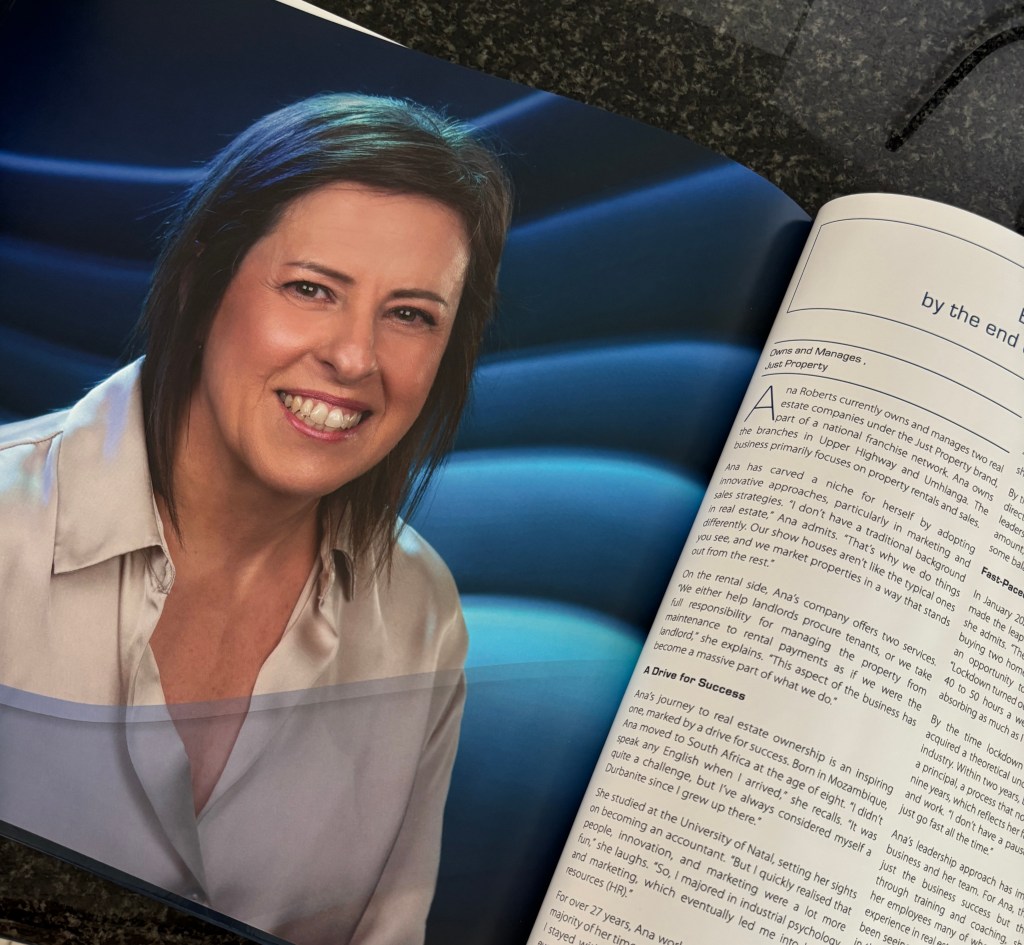
  • Overcoming Fear: My Leap into Real Estate at 50

    Overcoming Fear: My Leap into Real Estate at 50

    Ana Roberts 2025

    For most of my career, I lived and breathed human resources.
    Hard work led to results, results led to recognition, and recognition led to promotion. I climbed steadily, earning a senior position in a corporate world that was familiar, structured, and, if I’m honest — comfortable. I stayed with one organisation due to loyalty and comfort.

    It wasn’t ideal, but it was known. And known feels safe.

    Then life did what it does best — it disrupted the plan. A curveball. Big one! Circumstances changed, and suddenly, comfort was no longer an option.

    At 50-plenty, I made a choice that terrified me: I left what I knew and stepped into real estate — an industry I had zero experience in. No track record. No handbook. Just a clear vision, strong values, and a fierce determination to figure it out.

    The Steep Learning Curve

    The learning curve wasn’t just steep — it was vertical. Every day demanded discipline, focus, and humility. I had to build credibility from scratch, learn legislation, processes, new systems, navigate new challenges, and adapt to a world where results were instant and visible. I was doing this from the front, not as an agent but as a franchise leader. I knew many people were waiting for me to fall.

    But with integrity, innovation, and excellence as my anchors, the impossible started becoming achievable. Slowly, a business began to grow — one built not just on numbers, but on people, purpose, and principle.

    The Power of Choice

    Change is uncomfortable. Sometimes it’s terrifying. There were moments I wanted to run back to what I knew — the safety of the familiar, the predictability of the old routine. But every time I looked back, I reminded myself: comfort is not the same as contentment.

    Today, I’m where I truly want to be — leading a business that reflects my values, surrounded by a team that shares my vision, and proving (mostly to myself) that it’s never too late to reinvent your path.

    The Curveball

    If you’re standing at the edge of change — take the leap.
    It will be scary. It will be messy. But it will also be extraordinary.

    Because sometimes the hardest choices carry the greatest rewards.

  • What You’ll Find Between the Coffee and the Curveballs

    What You’ll Find Between the Coffee and the Curveballs

    Because coffee is essential for survival, culture makes or breaks a business, and life… well, life always throws a few curveballs.

    Every good series needs an introduction, so here’s mine. It’s not a blueprint, not a textbook, and certainly not a “10 steps to guaranteed success” kind of thing (if only it were that simple). This is just me — sharing what I’ve learned, what I’ve messed up, what I’ve tried, and what I’ve seen in business, leadership, and life.

    The series is called Coffee, Culture & Curveballs for three reasons:

    1. Coffee is essential. Without it, most of us wouldn’t make it through the first email of the day, never mind a board meeting.
    2. Culture is the heartbeat of any business. It’s what keeps strategy alive, teams motivated, and clients coming back. Get it right, and everything flows. Get it wrong, and… well, you’ll be needing more coffee.
    3. Curveballs are inevitable. Life, leadership, real estate, business — they all have a way of throwing surprises when you least expect them. Some you swing at and miss, some you connect with beautifully, and some smack you square on the head and leave you dazed for a bit.

    I’m not writing this series because I have all the answers. Far from it. If leadership has taught me anything, it’s that nobody really has it all figured out. We’re all just trying, failing, adjusting, and trying again. But along the way, I’ve read books that made me rethink everything, worked with people who taught me lessons (sometimes the hard way), and lived through experiences that were equal parts humbling, frustrating, and funny in hindsight.

    Some of what I’ll share will be lessons in leadership, some in running a business, and some in just navigating life when it feels like the universe is throwing curveballs faster than you can duck. I’ll share what worked, what didn’t, and what I’d never, ever do again (consider this a gift to your future self).

    You’ll find stories about hiring the right people, protecting culture like your life depends on it, stepping out of comfort zones, avoiding the dreaded “rotten apple hire,” and the ongoing battle of resisting easy wins when the long game matters more. And yes, there will be dinosaurs, apples, and the occasional dodgy metaphor involving Wi-Fi.

    This isn’t about being perfect. It’s about being intentional. It’s about leading in a way that balances business goals with human realities. And it’s about remembering that coffee, culture, and curveballs aren’t just catchy words — they’re the daily reality of anyone trying to lead, grow, and survive in business. So grab a cup, settle in, and join me for the ride. I can’t promise I’ll always be right, but I can promise it’ll be honest, light-hearted, and hopefully useful. And if nothing else, at least you’ll get a laugh or two along the way.