
Tag: life

  • Mastering Real Estate: Keys to Lasting Success

    Real estate coffee

    Real estate isn’t for the faint-hearted. It’s for the caffeinated, culture-loving curveball-dodgers who show up, suit up, and smile anyway.

    If there’s one thing the property world has taught me, it’s that success—in the real estate sense of the word—has very little to do with glossy brochures, shiny shoes, or how convincingly you can pronounce “exclusive mandate.” Those are nice-to-haves. Accessories. Decorative scatter cushions on the couch of competence. The real muscle behind a thriving, sustainable career in real estate? It’s discipline, hunger, knowledge, genuine interest in people, and a brand so tight that even your shadow knows the strategy.

    Let’s start with the not-so-sexy word: discipline. Oh yes, that reliable old friend who insists on waking you up before sunrise, even when you were up late negotiating an OTP with someone who “just needs one more family meeting.” Discipline is that internal engine that keeps you making calls when you’d rather scroll Instagram for inspiration you’re definitely not going to implement. It’s what separates those who “try real estate for a bit” from those who build legacies. It’s showing up when it rains, when the deal dies, when the seller ghosts you, and when the tenant sends a voice note longer than your last holiday.

    Hope and talent are lovely, but discipline is what pays the bills.

    Then there’s hunger—and not the “forgot-my-breakfast” type. I’m talking about that driving, determined, almost candy-floss-at-the-funfair craving to win. The kind the Springboks have in their veins. That unshakeable “we’re bringing this home” conviction. Without hunger, you may make it to the finals of your career, but you won’t win the cup. And real estate—South African real estate in particular—demands this edge. If you’re satisfied with “any medal,” you’ll likely end up with none. Winners are made from consistent daily actions driven by a deep, internal desire to achieve exceptional results, not fluke luck and a smile.

    Of course, success isn’t just a mindset. Knowledge matters—deep, real, relevant knowledge. Not the copy-and-paste kind. True property professionals are constantly learning: legislation, zoning nuances, market shifts, interest-rate implications, rental-trend patterns, buyer psychology. The works. If you want to be taken seriously, you have to know your craft. And the moment you think you know enough? Congratulations. You’ve just fallen behind.

    But let’s be honest: people don’t remember you because you can cite section numbers off the Rental Housing Act with the flair of a courtroom drama. They remember because you’re interested in them. They feel seen, heard, understood. Which brings me to one of our most undervalued but industry-defining skills: genuine interest in people. If you can’t connect, you can’t help—and if you can’t help, you can’t sell. Simple.

    Real estate is a relationship business disguised as a property business. You’re not selling bricks—you’re selling futures, lifestyle choices, peace of mind, certainty, belonging. And to do that well, you need the ability to relate, understand needs, influence, and gently persuade (not the pushy kind; think more “taste this thirst-quencher,” less “drink this cold drink or else”). The power lies in asking questions, not dumping data. The client’s story, not yours.

    Now, that’s how you succeed today. But the future? That’s a different beast. A faster beast. A beast with LED lights and an app.

    To survive and thrive in the years ahead, you’ll need more than discipline and hunger—you’ll need brand differentiation, innovation, and a willingness to do things differently. The real estate world is changing faster than interest rates after a Reserve Bank meeting. Technology is no longer a “nice to have”—it’s your new assistant, your silent partner, your personal caffeine IV drip. Use it. Embrace it. Automate where you can. Adapt where you must.

    And please—be professional. It’s astonishing that this even needs to be said, but professionalism will increasingly separate the rats from the mice. Clients have choices. They want competence, clarity, consistency, and conduct that reflects well on the brand. One unprofessional moment spreads quicker than a voice note in a family WhatsApp group. One bad apple—regardless of their impressive numbers—can taint an entire brand. Culture and reputation are fragile things; guard them like the last piece of Lindt in the office fridge.

    Which brings us to the backbone of any agency that intends not only to survive but to soar: vision, strategy, and brand image.

    If your brand cannot articulate where it’s going, what it stands for, and what it refuses to tolerate, the market will define it for you—and it won’t be flattering. Future-focused agencies are built on a clear vision supported by well-defined values that aren’t just laminated on the wall—they’re lived, breathed, and demonstrated daily. They’re expressed in every online post, every open-house conversation, every follow-up email, every handshake, every decision.

    And yes, clarity and consistency matter. Mixed messages confuse both your staff and your market. Brands that show up with well-aligned, unmistakably consistent communication will stand out in a sea of sameness. Those are the flyers—the ones who rise above, innovate, stay relevant, and deliver long after others have fizzled out. Then you have the survivors—steady, capable, hanging in. And finally… the demisers. The ones who cling to “how we’ve always done it” until the industry leaves them behind like dial-up internet.

    The future belongs to those who combine old-school values—discipline, hunger, integrity, genuine human connection—with new-school tactics: technology, innovation, differentiation, and forward-thinking strategy. The magic is in the blend. The espresso and the milk. The culture and the curveballs.

    Real estate is simple, but it’s not easy. It demands grit, heart, brainpower, and a sense of humour (because without that, you will not survive the tenant who wants to pay rent “as soon as my Forex clears”). But for those willing to learn, adapt, and lead with clarity and purpose, the next chapter of real estate isn’t just bright—it’s golden.

    And that’s the thing about success in this industry: it’s not a moment. It’s a method. It’s not luck. It’s leadership. And it’s not for everyone. But for the caffeinated, culture-driven, curveball-catching few?

    It’s where we fly.
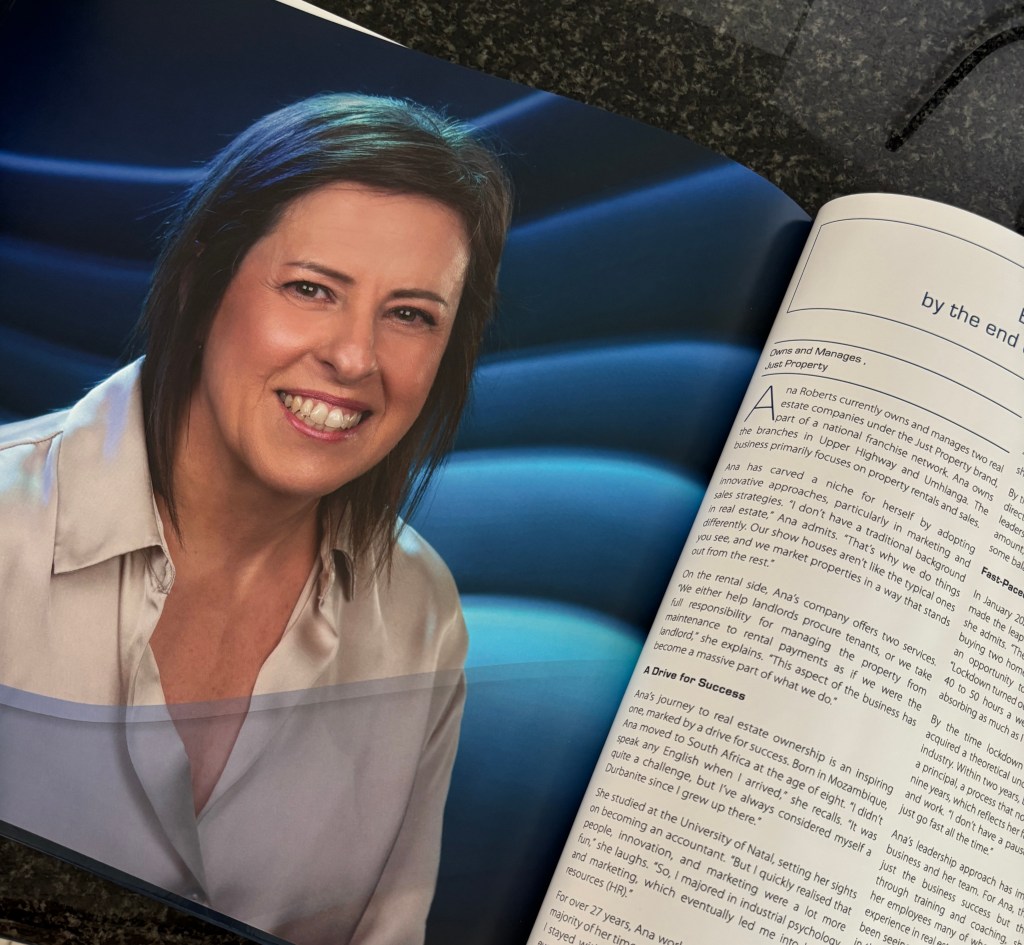
  • Overcoming Fear: My Leap into Real Estate at 50

    Overcoming Fear: My Leap into Real Estate at 50

    Ana Roberts 2025

    For most of my career, I lived and breathed human resources.
    Hard work led to results, results led to recognition, and recognition led to promotion. I climbed steadily, earning a senior position in a corporate world that was familiar, structured, and, if I’m honest — comfortable. I stayed with one organisation due to loyalty and comfort.

    It wasn’t ideal, but it was known. And known feels safe.

    Then life did what it does best — it disrupted the plan. A curveball. Big one! Circumstances changed, and suddenly, comfort was no longer an option.

    At 50-plenty, I made a choice that terrified me: I left what I knew and stepped into real estate — an industry I had zero experience in. No track record. No handbook. Just a clear vision, strong values, and a fierce determination to figure it out.

    The Steep Learning Curve

    The learning curve wasn’t just steep — it was vertical. Every day demanded discipline, focus, and humility. I had to build credibility from scratch, learn legislation, processes, new systems, navigate new challenges, and adapt to a world where results were instant and visible. I was doing this from the front, not as an agent but as a franchise leader. I knew many people were waiting for me to fall.

    But with integrity, innovation, and excellence as my anchors, the impossible started becoming achievable. Slowly, a business began to grow — one built not just on numbers, but on people, purpose, and principle.

    The Power of Choice

    Change is uncomfortable. Sometimes it’s terrifying. There were moments I wanted to run back to what I knew — the safety of the familiar, the predictability of the old routine. But every time I looked back, I reminded myself: comfort is not the same as contentment.

    Today, I’m where I truly want to be — leading a business that reflects my values, surrounded by a team that shares my vision, and proving (mostly to myself) that it’s never too late to reinvent your path.

    The Curveball

    If you’re standing at the edge of change — take the leap.
    It will be scary. It will be messy. But it will also be extraordinary.

    Because sometimes the hardest choices carry the greatest rewards.

  • Why Businesses Must Embrace Change to Survive

    Why Businesses Must Embrace Change to Survive

    Because coffee is essential for survival, culture makes or breaks a business, and life… well, life always throws a few curveballs.

    Doing things the way they’ve always been done is comfortable. It’s familiar. It doesn’t ask too many questions, doesn’t demand too much effort, and lets everyone get on with their day without rocking the boat. It’s the business equivalent of ordering the same takeaway every Friday night — no surprises, no stress, and no chance of discovering something new.

    The current way is proven, right? It got you this far. And yes, it requires less effort than sitting down to rethink how things could be better. But here’s the thing: “the way it’s always been done” has one big problem. At some point, it stops working. Dinosaurs did things the same way for a very long time too… and we know how that ended.

    It’s easy to confuse “what worked yesterday” with “what will work tomorrow.” Businesses fall into this trap all the time. They perfect their systems, they polish their processes, and then they stop looking ahead. For a while, the results keep coming in, and everyone pats themselves on the back for sticking to the formula. But then the market shifts, technology evolves, customer expectations change — and suddenly the formula isn’t delivering. The dinosaur is still stomping around proudly, but the asteroid is already on the way.

    Courage

    Clinging to old ways feels safe. Innovation feels risky. It requires energy, creativity, and often investment. And sometimes it fails — which is terrifying for leaders who are trying to protect the business. But the bigger risk is not failing at innovation. The bigger risk is failing to innovate at all. Because in business, standing still is not neutral. Standing still is falling behind.

    The danger is subtle at first. Maybe you lose a deal to a competitor who’s adopted new technology. Maybe your once-loyal clients drift toward someone who offers a slicker, more modern service. Maybe your team feels frustrated because they can see the world moving on, but leadership won’t budge from “the way we’ve always done it.” Eventually, the gap grows too wide to ignore. And what used to be a strength — your consistency, your predictability — becomes a weakness.

    This is why leaders need to resist the comfort zone. A comfort zone is a great place to rest, but it’s a terrible place to build a business. Innovation doesn’t mean reinventing everything overnight. It means having the courage to ask uncomfortable questions. Is this process still working? Is there a smarter way to do this? Does this strategy prepare us for the next five years, or just get us through the next five months?

    And let’s be clear: not all traditions are bad. Some old ways survive because they really do work. But they only stay effective because someone, at some point, checked whether they still made sense. The key isn’t to throw everything out; the key is to keep testing what you’ve got against the world you’re operating in. A business that refuses to test its assumptions is a business that’s waiting for extinction.

    So yes, doing things the way you’ve always done them is easier. It’s the low-effort, low-risk option. But easy doesn’t build the future. Easy doesn’t differentiate you from competitors. Easy doesn’t inspire your team or excite your clients. Some leaders build teams around this and think they are doing a fabulous job. Easy is just… easy. And in business, easy almost always comes before irrelevant.

    The challenge

    The challenge for every leader is to balance the comfort of what works with the curiosity of what could work better. To resist the temptation of sitting in yesterday’s success and instead keep asking what tomorrow demands. Because in the end, the businesses that thrive are the ones that evolve. They adapt, they innovate, they embrace change. They don’t wait for the asteroid.

    The leadership lesson is simple: don’t be a dinosaur. Respect the past, but don’t live in it. Keep moving forward, even if it’s uncomfortable. Especially if it’s uncomfortable. Because discomfort is the sign that you’re growing, while comfort is the sign that you’ve stopped. And in business, once you’ve stopped, it’s only a matter of time before you’re nothing more than a fossil.