Tag: life

  • Reviving Real Estate Success: Essential Self-Reflection Strategies

    Thriving in real estate is like proteas growing in tough environments

    Few things are more frustrating for a property practitioner than putting in effort and not seeing the results you expected.

    You arrive early, stay late, attend show houses, make calls, follow up on leads and spend countless hours trying to move transactions forward. Yet despite your efforts, the listings aren’t coming in, the sales aren’t closing or the rental mandates aren’t materialising. The harder you seem to work, the more elusive success becomes.

    Every property practitioner experiences this at some point in their career.

    The challenge is that when results decline, many people immediately focus on external factors. They blame the market, interest rates, competition, consumer confidence, social media algorithms, the economy or the company they work for. While all of these factors can certainly influence outcomes, they are rarely the whole story.

    The most successful practitioners understand that when results are not where they should be, the first place to look is not outward—it is inward.

    That can be uncomfortable because it requires honesty. It requires asking difficult questions and being willing to challenge assumptions. It requires moving beyond excuses and focusing on what can actually be controlled.

    The first question every practitioner should ask is simple: Am I doing enough of the right activities?

    Many people confuse being busy with being productive. Real estate offers endless opportunities to feel busy. Emails, administration, social media, meetings, property viewings and paperwork can consume entire days. However, not all activities contribute equally to business growth. If your results are declining, it is worth examining how much time is actually being spent on activities that generate new opportunities.

    Prospecting remains one of the most important drivers of success in real estate, yet it is often the first activity practitioners reduce when they become busy. Ironically, this creates a dangerous cycle. Fewer conversations today result in fewer opportunities tomorrow. When business slows down, the answer is often not to do more of everything. It is to do more of the activities that directly create future business.

    The second question is whether your skills have kept pace with the market. The ever changing market. Are you willing to adapt?

    The industry has changed significantly over the last few years. Consumers are more informed, competition is more intense and expectations are higher than ever before. Techniques that worked five or ten years ago may no longer be producing the same results. Buyers and sellers expect expertise, insight and value. They want professionals who understand the market, communicate effectively and provide guidance throughout the process.

    If your conversion rates are declining, it may not be because opportunities are disappearing. It may be because your approach needs refinement. This is where training, coaching and continuous development become critical. The best practitioners never assume they have learned everything. They remain students of their profession, constantly looking for ways to improve.

    Another important area to examine is mindset.

    When results are poor, confidence often takes a knock. Rejection feels more personal. Small setbacks feel larger. Doubt begins to creep in. Before long, practitioners start approaching conversations with uncertainty rather than confidence. Clients pick up on this far more quickly than many people realise.

    The danger is that poor results can create a self-fulfilling cycle. Reduced confidence leads to reduced activity. Reduced activity leads to fewer opportunities. Fewer opportunities lead to poorer results. Breaking that cycle often requires action before confidence returns rather than waiting for confidence to magically appear.

    One of the greatest misconceptions in sales is that motivation creates action. In reality, action often creates motivation.

    Making the calls, attending the appointments, improving your skills and consistently showing up every day can gradually rebuild confidence. Waiting until you feel motivated before taking action rarely works. Going back to basics, taking the first step and then the next and the next and maintaining the discipline to keep going everyday.

    It is also worth taking an honest look at your environment.

    The people around you have a significant influence on your performance. Are you surrounded by professionals who challenge and support you? Are you receiving meaningful coaching and feedback? Does your organisation provide the training, systems and leadership required to help you succeed? Are there people around you who are achieving the results you aspire to achieve?

    Sometimes the issue is not capability. Sometimes it is environment.

    Great practitioners thrive in environments that encourage growth, accountability and continuous improvement. If your current environment is not helping you develop, it may be worth considering whether it is the right place for your next chapter.

    However, changing environments should never be used as a substitute for self-reflection. A new company, new brand or new commission structure cannot compensate for habits that need to change. Wherever you go, you take yourself with you.

    It is however, easy to blame the manager or the environment for lack of results – this is not usually the answer. You are in control of your business. How far are you willing to go?

    One of the most valuable exercises any practitioner can undertake is to stop comparing themselves to others and start comparing themselves to their own potential. It is easy to become discouraged when looking at top performers and wondering why their success seems effortless. What is often invisible is the consistency, discipline and persistence that sits behind those results.

    Success in real estate rarely happens overnight. More often, it is the cumulative effect of hundreds of small actions performed consistently over time.

    The practitioners who ultimately succeed are not always the most talented. They are often the most resilient. They are the ones who continue learning when others stop, continue prospecting when others become distracted and continue showing up when results are temporarily absent.

    Every career includes periods where progress feels slower than expected. Every practitioner experiences moments of doubt. The difference lies in how those moments are handled.

    When results are not where they need to be, resist the temptation to look for a quick fix. Instead, focus on the fundamentals. Review your activities. Assess your skills. Strengthen your mindset. Seek feedback. Invest in your development. Surround yourself with the right people and remain committed to the process.

    Because while markets change, technologies evolve and consumer behaviour shifts, one principle remains remarkably consistent. Innovation and knowledge are becoming more important with every change.

    The practitioners who are willing to adapt, learn and persist are usually the ones who find their way back to success.

    Coffee, Culture & Curveballs reminds me that success is rarely lost overnight and it is rarely regained overnight. More often, it is rebuilt through small, consistent actions repeated long after the initial frustration has passed. The results may not arrive immediately, but they almost always arrive for those who refuse to stop growing.


  • Mastering Emotional Intelligence in the Workplace

    A calm path to productivity

    One of the greatest challenges in any workplace is learning how to separate emotion from performance.

    That statement may sound cold at first. After all, workplaces are filled with people, and people are emotional beings. We experience frustration, disappointment, excitement, anxiety, pride and countless other emotions throughout our days. It would be unrealistic—and unhealthy—to pretend those emotions do not exist.

    The problem arises when emotions begin driving our decisions, behaviours and performance rather than informing them.

    In today’s world, there is a great deal of emphasis placed on emotional intelligence, and rightly so. Understanding emotions, both our own and those of others, is an important life skill. However, emotional intelligence is not about allowing emotions to control us. It is about recognising them, understanding them and then deciding how we respond. The distinction is critical.

    Every workplace experiences challenges. Deadlines are missed. Feedback is delivered. Decisions are made that not everyone agrees with. Colleagues have different personalities, working styles and opinions. Clients can be demanding. Markets can be difficult. Mistakes happen. If every disappointment, disagreement or frustration becomes an emotional event, productivity inevitably suffers.

    I have often observed that the happiest and most successful professionals are not necessarily the most talented people in the room. They are the people who have learned how to create a healthy separation between what happens at work and how they feel about themselves as individuals. They understand that feedback about a task is not criticism of their character. A missed deadline is not a judgment of their worth. A difference of opinion is not a personal attack.

    When people struggle to make this distinction, everything becomes personal. Constructive feedback feels like criticism. Questions feel like accusations. Accountability feels like punishment. Everyday workplace interactions become emotionally exhausting because they are interpreted through a personal lens rather than a professional one.

    The result is often unnecessary conflict, reduced performance and increased stress. People spend more energy managing emotions than solving problems. Discussions become defensive instead of productive. Focus shifts away from achieving outcomes and towards protecting feelings. While feelings matter, they should never become more important than the objective itself.

    The most effective workplaces are those where people can discuss issues openly without taking them personally. Team members are able to challenge ideas without damaging relationships. Leaders can provide honest feedback without being accused of personal attacks. Employees can disagree with decisions while still supporting the direction of the business. This level of professionalism creates an environment where problems are solved quickly, communication improves and trust grows.

    One of the most valuable lessons I have learned is that professionalism is not the absence of emotion. It is the ability to manage emotion appropriately. Being professional does not mean suppressing your feelings or pretending not to care. It means recognising when emotions are influencing your thinking and ensuring they do not dictate your actions.

    For example, if you receive feedback that disappoints you, it is perfectly normal to feel frustrated. The professional response is not to deny the feeling exists. The professional response is to acknowledge the feeling, process it appropriately and then focus on what can be learned or improved. Similarly, if a colleague behaves in a way that irritates you, professionalism means addressing the issue constructively rather than allowing resentment to build or reacting impulsively.

    When individuals learn to separate emotions from performance, something remarkable happens. Productivity improves because energy is directed towards solutions rather than conflict. Relationships improve because people stop assuming negative intent. Accountability becomes easier because feedback is seen as an opportunity for growth rather than a threat. Teams become more resilient because they are able to navigate challenges without becoming emotionally derailed.

    Perhaps even more importantly, happiness in the workplace increases. This may sound counterintuitive, but much of the stress people experience at work comes from emotional interpretation rather than the actual situation itself. The more personally we take every setback, disagreement or piece of feedback, the heavier work becomes. By creating some emotional distance, we give ourselves the freedom to focus on what truly matters and let go of what does not.

    This does not mean becoming detached, uncaring or robotic. Quite the opposite. The healthiest workplaces are often those where people care deeply about their work and about one another. The difference is that they have learned how to separate the issue from the individual. They understand that a challenging conversation can still be respectful, that accountability can still be kind and that disagreement does not have to damage relationships.

    The reality is that work is, by definition, about performance. Organisations exist to achieve outcomes, serve clients, solve problems and create value. Every employee, regardless of role, contributes to that purpose. When emotions consistently overshadow performance, everyone suffers. Individuals become frustrated, teams become strained and organisational goals become harder to achieve.

    Learning to manage emotions effectively is therefore not simply a professional skill—it is a life skill. It allows us to navigate challenges with greater clarity, maintain stronger relationships and perform at a higher level. It helps us focus on what we can control rather than becoming consumed by what we feel in a particular moment.

    At the end of the day, separating emotion from performance is not about becoming less human. It is about becoming more intentional. It is about recognising that emotions are valuable sources of information, but poor decision-makers. They should be acknowledged, understood and respected, but they should not be given the steering wheel.

    The most successful and fulfilled professionals are not those who never experience emotion. They are those who have learned how to feel deeply, think clearly and act professionally.

    That balance is where both performance and happiness thrive.

    Coffee, Culture & Curveballs reminds me that emotions are part of every workplace, but they were never meant to run it. When we learn to separate how we feel from what needs to be done, we create space for better decisions, stronger relationships and greater success—for ourselves and for those around us.

  • Choosing Wellness Over Company Prestige

    Coffee, Culture & Curveballs

    Looking into the horizon the sun rises every morning.

    There is a question I have often found myself asking people who are unhappy in their jobs.

    If this company had a different name on the building, would you still stay?

    The answer is often revealing.

    Many talented, capable people remain in environments that drain their energy, damage their confidence and negatively impact their wellbeing because they are attached to the brand rather than the experience. They stay because the company is well known. They stay because it carries prestige. They stay because friends, family or clients recognise the name. They stay because being associated with the brand feels successful, even when the reality of working there feels anything but.

    It is understandable. Strong brands have power. They create a sense of belonging, credibility and status. Being part of a respected organisation can open doors and create opportunities. There is nothing wrong with taking pride in the company you work for. In fact, it is something many people actively seek when making career decisions.

    The problem arises when the strength of the brand begins to overshadow the quality of the environment.

    A famous logo cannot compensate for poor leadership. Market share cannot make up for a toxic culture. Industry reputation does not erase the impact of constant stress, unhealthy relationships or a lack of respect. Yet every day, people convince themselves to stay because they believe the brand is worth the sacrifice.

    Over time, they begin to normalise things that should never be normal.

    They accept being spoken to disrespectfully because “that’s just how things are here.” They tolerate unrealistic expectations because the company is successful. They overlook poor communication, favouritism, politics or a lack of support because they do not want to walk away from a recognised name. Gradually, what once felt uncomfortable becomes familiar, and familiarity has a way of disguising dysfunction.

    One of the greatest dangers of a strong brand is that it can create the illusion that leaving would be a step backwards. People convince themselves that no other organisation could offer the same opportunities, exposure or credibility. They become so focused on what they might lose that they stop considering what they might gain.

    The reality is that careers are built on much more than brand names.

    They are built on learning, growth, relationships, confidence and the ability to perform at your best. They are built in environments where people are supported, challenged appropriately and treated with respect. A prestigious company may look impressive on a LinkedIn profile, but if it leaves you exhausted, anxious or questioning your own worth every day, its value becomes far more questionable.

    I have met people who stayed in toxic environments for years because they believed the brand would somehow make the sacrifice worthwhile. Many eventually left, only to discover that the world did not end. In fact, quite the opposite happened. They found organisations with healthier cultures, stronger leadership and greater opportunities for personal growth. Some earned more. Some achieved better work-life balance. Many rediscovered a level of confidence they had forgotten they possessed.

    What struck me most was how often they wished they had made the move sooner.

    That is not to say every difficult workplace is toxic. Every organisation faces challenges. Every job includes frustrations. Every leader makes mistakes. There is an important distinction between a demanding environment and a damaging one. Growth often requires discomfort. Toxicity creates harm. One helps people develop. The other slowly erodes them.

    The challenge is that toxicity does not always arrive dramatically. It often develops gradually through repeated patterns. It appears in leaders who consistently undermine rather than develop. It appears in cultures where fear replaces trust, where politics replace collaboration and where people are valued only for what they produce rather than who they are. Individually, these moments may seem manageable. Collectively, they create an environment that becomes increasingly difficult to thrive within.

    Perhaps the most important thing people need to remember is that brands do not create culture. People do.

    A company’s reputation in the marketplace may be excellent while the internal experience is deeply flawed. Customers see the external brand. Employees experience the internal reality. Those two things are not always the same.

    When evaluating a career opportunity—or deciding whether to remain where you are—the questions should extend far beyond the logo on the business card. Does the environment align with your values? Are you respected? Are you developing? Are you supported when challenges arise? Do you trust the leadership? Are you becoming a better version of yourself by being there?

    Those questions matter far more than the name on the building.

    Life is too short and careers are too long to spend years in an environment that consistently diminishes your wellbeing simply because the brand looks impressive from the outside. The strongest brands in the world cannot compensate for a culture that damages the people within it.

    At some point, every professional must decide what they value most: the comfort of being associated with a recognised name or the opportunity to work in an environment where they can genuinely thrive.

    The answer may be different for each person, but one thing is certain. Whilst a strong brand can enhance your career, it should never be the reason you sacrifice yourself for it.

    Coffee, Culture & Curveballs reminds me that the most important reputation is not the one printed on your business card. It is the one you build within yourself. No brand, no matter how powerful, is worth losing your confidence, your wellbeing or your sense of purpose.

  • Where Have I Been?

    Coffee, Culture & Curveballs

    Cup of dark coffee with cream pouring in and swirling pattern

    It’s been a while since I last sat down to write for Coffee, Culture & Curveballs. Long enough, in fact, that a few people have asked whether I had abandoned the blog altogether. The answer is no—at least not intentionally. Like many things in life, writing quietly slipped down the priority list while other responsibilities worked their way to the top. Businesses needed attention, people needed support, problems needed solving and deadlines needed meeting. Life happened. Somewhere between the coffee and the curveballs, the writing paused.

    The irony is that I started this blog because I believed reflection mattered. I believed that the lessons we learn along the way are worth sharing and that there is value in pausing long enough to make sense of life’s twists, turns and unexpected detours. I still believe all of those things. Yet over the past few months, I’ve found myself doing exactly what so many of us do. I’ve been so busy living life that I’ve forgotten to reflect on it.

    Perhaps that is one of the reasons so many people feel exhausted today. We move from task to task, meeting to meeting and challenge to challenge without ever taking the time to ask ourselves what we’re learning along the way. We are constantly producing but rarely processing. We collect experiences without extracting the lessons. We focus so intently on moving forward that we forget to look inward.

    This season has taught me a great deal. It has reminded me that growth doesn’t always happen in public and that not every lesson arrives wrapped in success. Some lessons come disguised as frustration. Others arrive through disappointment, uncertainty or plans that don’t unfold the way we expected. Sometimes the greatest periods of growth happen during the moments when we feel least certain about the path ahead. Those are the curveballs. And whether we welcome them or not, they often become our greatest teachers.

    Over the past few months, I have spent more time learning than writing. I’ve been adapting to change, navigating challenges and facing many of the same uncertainties that most people encounter at different stages of life and business. I’ve been reminded that resilience is not about having all the answers; it’s about continuing to move forward when the answers aren’t immediately obvious. More importantly, I’ve been reminded that stories are everywhere if we’re willing to pay attention to them.

    What I’ve come to realise is that this blog was never really about expertise. It was never about presenting myself as someone who has everything figured out. It was always about curiosity. It was about exploring the questions that make us think, challenge our assumptions and encourage us to grow. The best conversations, after all, rarely come from certainty. They come from reflection.

    So consider this a return rather than a restart. The coffee never stopped, and neither did the learning. The curveballs simply got bigger, faster and perhaps a little more frequent. But maybe that’s exactly why it’s time to start writing again.

    Because if there’s one thing this season has reminded me, it’s that the lessons worth sharing are often found in the moments when life doesn’t go according to plan. And judging by the curveballs that have come my way lately, there are plenty more stories still to tell.

    Until next time, keep the coffee hot, stay curious, and remember that even the unexpected detours can lead somewhere worthwhile.

  • Mastering Real Estate: Keys to Lasting Success

    Real estate coffee

    Real estate isn’t for the faint-hearted. It’s for the caffeinated, culture-loving curveball-dodgers who show up, suit up, and smile anyway.

    If there’s one thing the property world has taught me, it’s that success—in the real estate sense of the word—has very little to do with glossy brochures, shiny shoes, or how convincingly you can pronounce “exclusive mandate.” Those are nice-to-haves. Accessories. Decorative scatter cushions on the couch of competence. The real muscle behind a thriving, sustainable career in real estate? It’s discipline, hunger, knowledge, genuine interest in people, and a brand so tight that even your shadow knows the strategy.

    Let’s start with the not-so-sexy word: discipline. Oh yes, that reliable old friend who insists on waking you up before sunrise, even when you were up late negotiating an OTP with someone who “just needs one more family meeting.” Discipline is that internal engine that keeps you making calls when you’d rather scroll Instagram for inspiration you’re definitely not going to implement. It’s what separates those who “try real estate for a bit” from those who build legacies. It’s showing up when it rains, when the deal dies, when the seller ghosts you, and when the tenant sends a voice note longer than your last holiday.

    Hope and talent are lovely, but discipline is what pays the bills.

    Then there’s hunger—and not the “forgot-my-breakfast” type. I’m talking about that driving, determined, almost candy-floss-at-the-funfair craving to win. The kind the Springboks have in their veins. That unshakeable “we’re bringing this home” conviction. Without hunger, you may make it to the finals of your career, but you won’t win the cup. And real estate—South African real estate in particular—demands this edge. If you’re satisfied with “any medal,” you’ll likely end up with none. Winners are made from consistent daily actions driven by a deep, internal desire to achieve exceptional results, not fluke luck and a smile.

    Of course, success isn’t just a mindset. Knowledge matters—deep, real, relevant knowledge. Not the copy-and-paste kind. True property professionals are constantly learning: legislation, zoning nuances, market shifts, interest-rate implications, rental-trend patterns, buyer psychology. The works. If you want to be taken seriously, you have to know your craft. And the moment you think you know enough? Congratulations. You’ve just fallen behind.

    But let’s be honest: people don’t remember you because you can cite section numbers off the Rental Housing Act with the flair of a courtroom drama. They remember because you’re interested in them. They feel seen, heard, understood. Which brings me to one of our most undervalued but industry-defining skills: genuine interest in people. If you can’t connect, you can’t help—and if you can’t help, you can’t sell. Simple.

    Real estate is a relationship business disguised as a property business. You’re not selling bricks—you’re selling futures, lifestyle choices, peace of mind, certainty, belonging. And to do that well, you need the ability to relate, understand needs, influence, and gently persuade (not the pushy kind; think more “taste this thirst-quencher,” less “drink this cold drink or else”). The power lies in asking questions, not dumping data. The client’s story, not yours.

    Now, that’s how you succeed today. But the future? That’s a different beast. A faster beast. A beast with LED lights and an app.

    To survive and thrive in the years ahead, you’ll need more than discipline and hunger—you’ll need brand differentiation, innovation, and a willingness to do things differently. The real estate world is changing faster than interest rates after a Reserve Bank meeting. Technology is no longer a “nice to have”—it’s your new assistant, your silent partner, your personal caffeine IV drip. Use it. Embrace it. Automate where you can. Adapt where you must.

    And please—be professional. It’s astonishing that this even needs to be said, but professionalism will increasingly separate the rats from the mice. Clients have choices. They want competence, clarity, consistency, and conduct that reflects well on the brand. One unprofessional moment spreads quicker than a voice note in a family WhatsApp group. One bad apple—regardless of their impressive numbers—can taint an entire brand. Culture and reputation are fragile things; guard them like the last piece of Lindt in the office fridge.

    Which brings us to the backbone of any agency that intends not only to survive but to soar: vision, strategy, and brand image.

    If your brand cannot articulate where it’s going, what it stands for, and what it refuses to tolerate, the market will define it for you—and it won’t be flattering. Future-focused agencies are built on a clear vision supported by well-defined values that aren’t just laminated on the wall—they’re lived, breathed, and demonstrated daily. They’re expressed in every online post, every open-house conversation, every follow-up email, every handshake, every decision.

    And yes, clarity and consistency matter. Mixed messages confuse both your staff and your market. Brands that show up with well-aligned, unmistakably consistent communication will stand out in a sea of sameness. Those are the flyers—the ones who rise above, innovate, stay relevant, and deliver long after others have fizzled out. Then you have the survivors—steady, capable, hanging in. And finally… the demisers. The ones who cling to “how we’ve always done it” until the industry leaves them behind like dial-up internet.

    The future belongs to those who combine old-school values—discipline, hunger, integrity, genuine human connection—with new-school tactics: technology, innovation, differentiation, and forward-thinking strategy. The magic is in the blend. The espresso and the milk. The culture and the curveballs.

    Real estate is simple, but it’s not easy. It demands grit, heart, brainpower, and a sense of humour (because without that, you will not survive the tenant who wants to pay rent “as soon as my Forex clears”). But for those willing to learn, adapt, and lead with clarity and purpose, the next chapter of real estate isn’t just bright—it’s golden.

    And that’s the thing about success in this industry: it’s not a moment. It’s a method. It’s not luck. It’s leadership. And it’s not for everyone. But for the caffeinated, culture-driven, curveball-catching few?

    It’s where we fly.

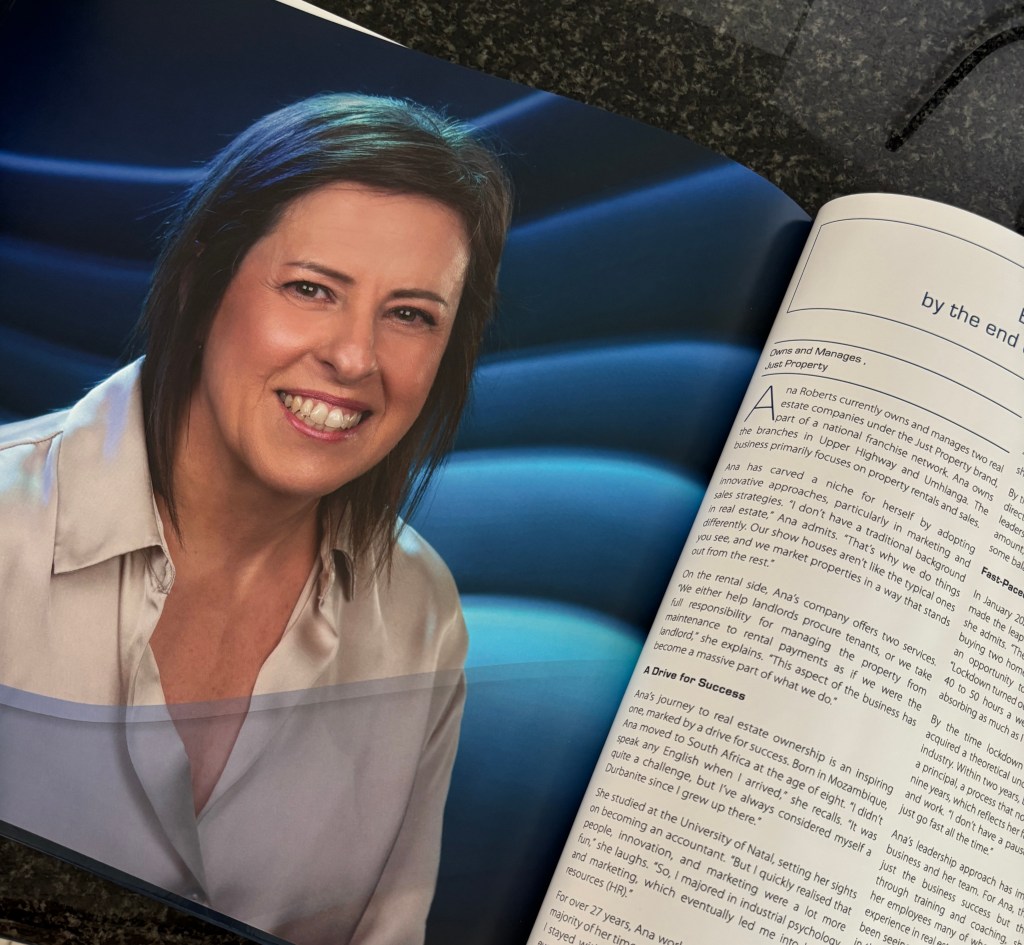
  • Overcoming Fear: My Leap into Real Estate at 50

    Overcoming Fear: My Leap into Real Estate at 50

    Ana Roberts 2025

    For most of my career, I lived and breathed human resources.
    Hard work led to results, results led to recognition, and recognition led to promotion. I climbed steadily, earning a senior position in a corporate world that was familiar, structured, and, if I’m honest — comfortable. I stayed with one organisation due to loyalty and comfort.

    It wasn’t ideal, but it was known. And known feels safe.

    Then life did what it does best — it disrupted the plan. A curveball. Big one! Circumstances changed, and suddenly, comfort was no longer an option.

    At 50-plenty, I made a choice that terrified me: I left what I knew and stepped into real estate — an industry I had zero experience in. No track record. No handbook. Just a clear vision, strong values, and a fierce determination to figure it out.

    The Steep Learning Curve

    The learning curve wasn’t just steep — it was vertical. Every day demanded discipline, focus, and humility. I had to build credibility from scratch, learn legislation, processes, new systems, navigate new challenges, and adapt to a world where results were instant and visible. I was doing this from the front, not as an agent but as a franchise leader. I knew many people were waiting for me to fall.

    But with integrity, innovation, and excellence as my anchors, the impossible started becoming achievable. Slowly, a business began to grow — one built not just on numbers, but on people, purpose, and principle.

    The Power of Choice

    Change is uncomfortable. Sometimes it’s terrifying. There were moments I wanted to run back to what I knew — the safety of the familiar, the predictability of the old routine. But every time I looked back, I reminded myself: comfort is not the same as contentment.

    Today, I’m where I truly want to be — leading a business that reflects my values, surrounded by a team that shares my vision, and proving (mostly to myself) that it’s never too late to reinvent your path.

    The Curveball

    If you’re standing at the edge of change — take the leap.
    It will be scary. It will be messy. But it will also be extraordinary.

    Because sometimes the hardest choices carry the greatest rewards.

  • Why Businesses Must Embrace Change to Survive

    Why Businesses Must Embrace Change to Survive

    Because coffee is essential for survival, culture makes or breaks a business, and life… well, life always throws a few curveballs.

    Doing things the way they’ve always been done is comfortable. It’s familiar. It doesn’t ask too many questions, doesn’t demand too much effort, and lets everyone get on with their day without rocking the boat. It’s the business equivalent of ordering the same takeaway every Friday night — no surprises, no stress, and no chance of discovering something new.

    The current way is proven, right? It got you this far. And yes, it requires less effort than sitting down to rethink how things could be better. But here’s the thing: “the way it’s always been done” has one big problem. At some point, it stops working. Dinosaurs did things the same way for a very long time too… and we know how that ended.

    It’s easy to confuse “what worked yesterday” with “what will work tomorrow.” Businesses fall into this trap all the time. They perfect their systems, they polish their processes, and then they stop looking ahead. For a while, the results keep coming in, and everyone pats themselves on the back for sticking to the formula. But then the market shifts, technology evolves, customer expectations change — and suddenly the formula isn’t delivering. The dinosaur is still stomping around proudly, but the asteroid is already on the way.

    Courage

    Clinging to old ways feels safe. Innovation feels risky. It requires energy, creativity, and often investment. And sometimes it fails — which is terrifying for leaders who are trying to protect the business. But the bigger risk is not failing at innovation. The bigger risk is failing to innovate at all. Because in business, standing still is not neutral. Standing still is falling behind.

    The danger is subtle at first. Maybe you lose a deal to a competitor who’s adopted new technology. Maybe your once-loyal clients drift toward someone who offers a slicker, more modern service. Maybe your team feels frustrated because they can see the world moving on, but leadership won’t budge from “the way we’ve always done it.” Eventually, the gap grows too wide to ignore. And what used to be a strength — your consistency, your predictability — becomes a weakness.

    This is why leaders need to resist the comfort zone. A comfort zone is a great place to rest, but it’s a terrible place to build a business. Innovation doesn’t mean reinventing everything overnight. It means having the courage to ask uncomfortable questions. Is this process still working? Is there a smarter way to do this? Does this strategy prepare us for the next five years, or just get us through the next five months?

    And let’s be clear: not all traditions are bad. Some old ways survive because they really do work. But they only stay effective because someone, at some point, checked whether they still made sense. The key isn’t to throw everything out; the key is to keep testing what you’ve got against the world you’re operating in. A business that refuses to test its assumptions is a business that’s waiting for extinction.

    So yes, doing things the way you’ve always done them is easier. It’s the low-effort, low-risk option. But easy doesn’t build the future. Easy doesn’t differentiate you from competitors. Easy doesn’t inspire your team or excite your clients. Some leaders build teams around this and think they are doing a fabulous job. Easy is just… easy. And in business, easy almost always comes before irrelevant.

    The challenge

    The challenge for every leader is to balance the comfort of what works with the curiosity of what could work better. To resist the temptation of sitting in yesterday’s success and instead keep asking what tomorrow demands. Because in the end, the businesses that thrive are the ones that evolve. They adapt, they innovate, they embrace change. They don’t wait for the asteroid.

    The leadership lesson is simple: don’t be a dinosaur. Respect the past, but don’t live in it. Keep moving forward, even if it’s uncomfortable. Especially if it’s uncomfortable. Because discomfort is the sign that you’re growing, while comfort is the sign that you’ve stopped. And in business, once you’ve stopped, it’s only a matter of time before you’re nothing more than a fossil.